Langtang: Running on a Land That Lost Everything — and Rebuilt Itself
By Gregory — Nepal Trail Running
There are places in the world where the mountain doesn't ask you to breathe. It grabs you by the gut. It shows you how small you are. It looks you in the eyes and forces you to slow down — through its elevation gain, through its altitude, through a silence that demands you listen. And above all, to feel things you never planned to feel.
Langtang is one of those places.
I've been here for a few days with Edgar — a runner, a friend — who is preparing for the Manjushree Trail Race 100 miles, one of the most demanding races in Nepal. We planned ten to fifteen days together. Climbing up to Kyanjin Gompa, tagging the summits around it, then running back down to Kathmandu. Snowy trails, the Langtang Valley, peaks between 7,000 and 8,000 metres flanking us at every step. I also came because this is a valley we are seriously considering adding to our future Nepal Trail Running camps. I wanted to feel it. To live it.
But very quickly on this trail, you understand there is something else here.
On April 25, 2015, something happened in this valley. Everyone knows there was one of the most powerful earthquakes Nepal has ever experienced. But Langtang was the human epicentre of that tragedy. And I want to talk about it. Because it is also part of why I want people to come and run here.
April 25, 2015. 11:56 AM.
A magnitude 7.8 earthquake — the Gorkha earthquake — shook Nepal with unimaginable violence. More than 8,900 people lost their lives across the country. Entire neighbourhoods of Kathmandu were destroyed. The world saw those images.
But in the Langtang Valley, about fifty kilometres north of the capital, something else happened. Nothing was filmed. Everything was lived.
Within seconds, the southern face of Langtang Lirung — one of the giants dominating the valley at 7,227 metres — broke away. Millions of tonnes of rock, ice and snow cascaded down the slopes at terrifying speed, generating an air pressure wave so powerful it flattened every tree on the opposite side of the valley for several kilometres downstream.
The village of Langtang was buried in seconds.
243 people. 175 villagers. 27 local guides and porters. 41 trekkers from around the world.
Even writing these words, I have tears in my eyes. I didn't expect it to hit me this hard.
You cannot prepare your heart for this.
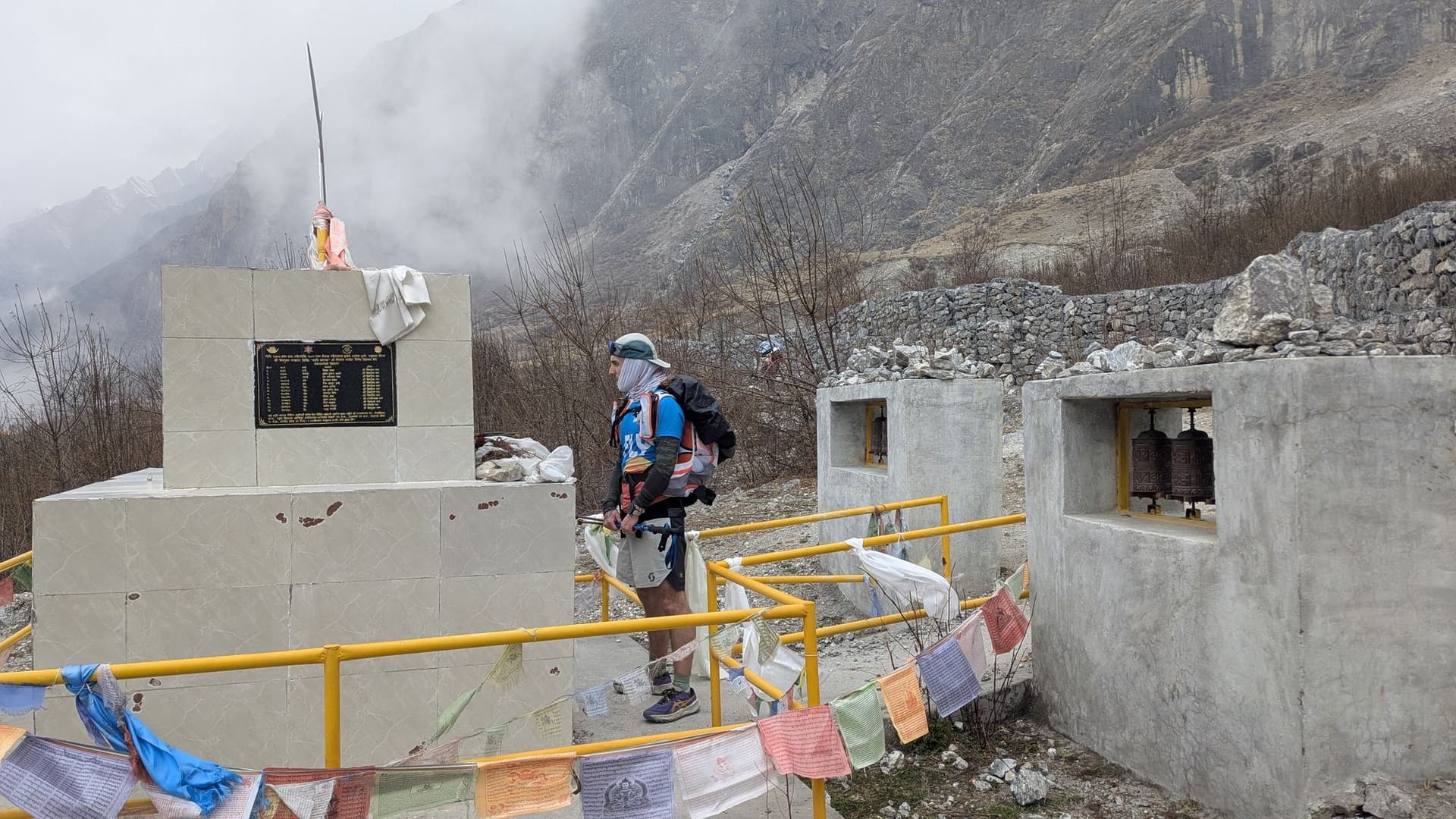
Arriving at Langtang village, you see memorials everywhere. Engraved stones. Prayer flags snapping in the cold wind. Plaques with names. And you arrive there a little out of breath, a little tired — you are already deep in Nepal's heart, you have already fallen in love with these people, you have already built connections with them in the villages below, you already know they all lost someone that day. And when you stand in front of that memorial… it is hard not to cry.
The lodges are all rebuilt — clean, solid. But the walls are still grey. No colour yet. Not quite. There is no road to this valley. Everything was carried up on foot, thirty kilometres of walking, to rebuild these lodges, to bring life back to this place.
It is a strange feeling, running through this landscape. The trails are technical, the terrain is beautiful, the altitude does its work. You move forward, you climb, you descend. But you cannot forget those 243 people. Who, on the morning of April 25th, were perhaps right here — just like us — walking, running, looking up at these same peaks.
A Community That Stood Back Up
What is most striking — what hits you the hardest — is that life came back.
The Tamang people, who have called this valley home for generations, did not abandon their land. They came back. They rebuilt everything. The lodges reopened. The trails were restored. At Kyanjin Gompa, at the top of the valley, there is a small artisan cheese dairy — yak cheese aged between six months and a year. There is Tibetan craftsmanship, because we are right on the doorstep of Tibet here. The monasteries have been rebuilt. And all around us, those summits that make you feel beautifully small.
And when you walk into a lodge in the evening — you are welcomed with smiles. By people who have surely lost many, many people around them. But who continue to hold onto that vivid joy, that delicious humour, that Nepali warmth that catches you completely off guard. That generosity is overwhelming. That ability to open their door, to keep smiling despite everything they have been through. It is deeply, deeply moving.
Why Running Here Changes Something
Edgar and I talk a lot. In the evenings, in the mornings, while we run.
We came to train seriously — and we are. Langtang is an incredible playground. Varied, technical, demanding trails, with altitude that works your legs and your lungs. But it flows well too, it has rhythm. From Kyanjin Gompa, you can push up to the surrounding summits — Tserko Ri at 4,985 metres, Kyanjin Ri — accessible, but with views that stop you in your tracks. The giants of the Himalayas, standing right there in front of you.
But beyond the performance, there is something else.
I come back to this often — why I created Nepal Trail Running. It wasn't for money. It was to return to the essence. To rediscover the joy of running. Running in these mountains is majestic. And there are not many of us running here — so we have the admiration of other trekkers, the curiosity of local people, and it creates something quite special. We give these mountains and these people incredible respect — and they give it back to us so completely.
That is Nepal. That is why I want to bring you here.
Because it is a reminder. That life is precious. That our finish times, our Strava segments — even if they matter, even if I am a competitor — are not really what counts. Places like this put us back in our place. And that is a privilege that should never be taken lightly.
What Comes Next
This expedition with Edgar is for us the starting point of a beautiful idea. Langtang deserves a place in our Nepal Trail Running camps. An accessible valley, magnificent trails, a rich culture, and a history that gives meaning to every kilometre you run.
We will tell you more very soon. I am going to go back, process all of these emotions, and work with my team to build a future camp here, in the Langtang. Because you need to come and run here.
In the meantime — whether you are preparing for a big race, whether you simply want to step away, recentre yourself, find yourself again, whether the mountains of the Himalayas are calling you — come and join us for one of our camps. We adapt to your goals, your level, your pace.
The best races are not always the ones we time.
🌐 trailrunningnepal.com