Annapurna Foothills Trail Running Camp — 6 Days, 135 km
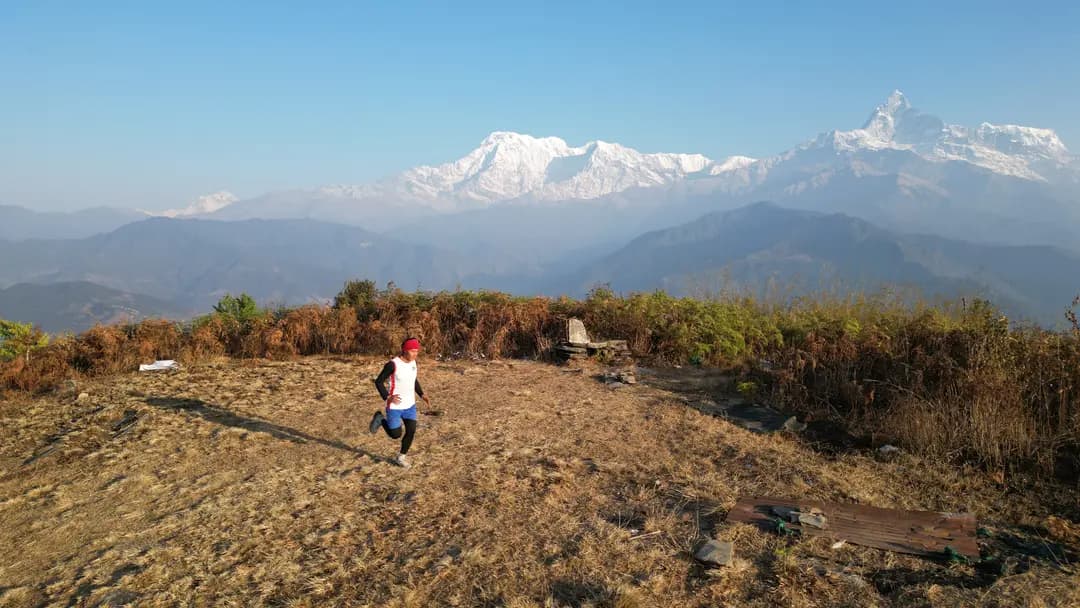
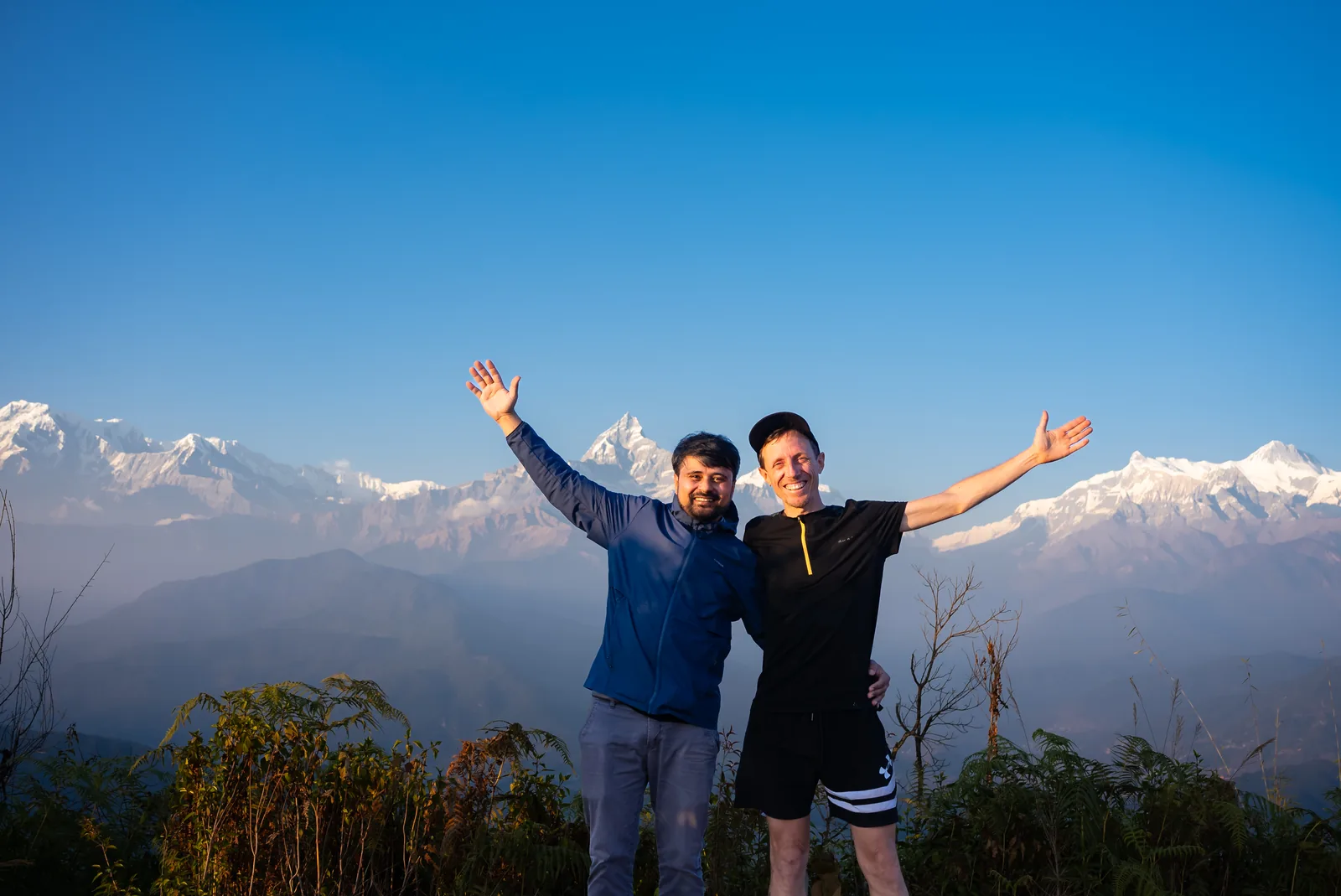
Two trail runners, six days, and an entire mountain range unfolding in front of them. This is the Annapurna Foothills.
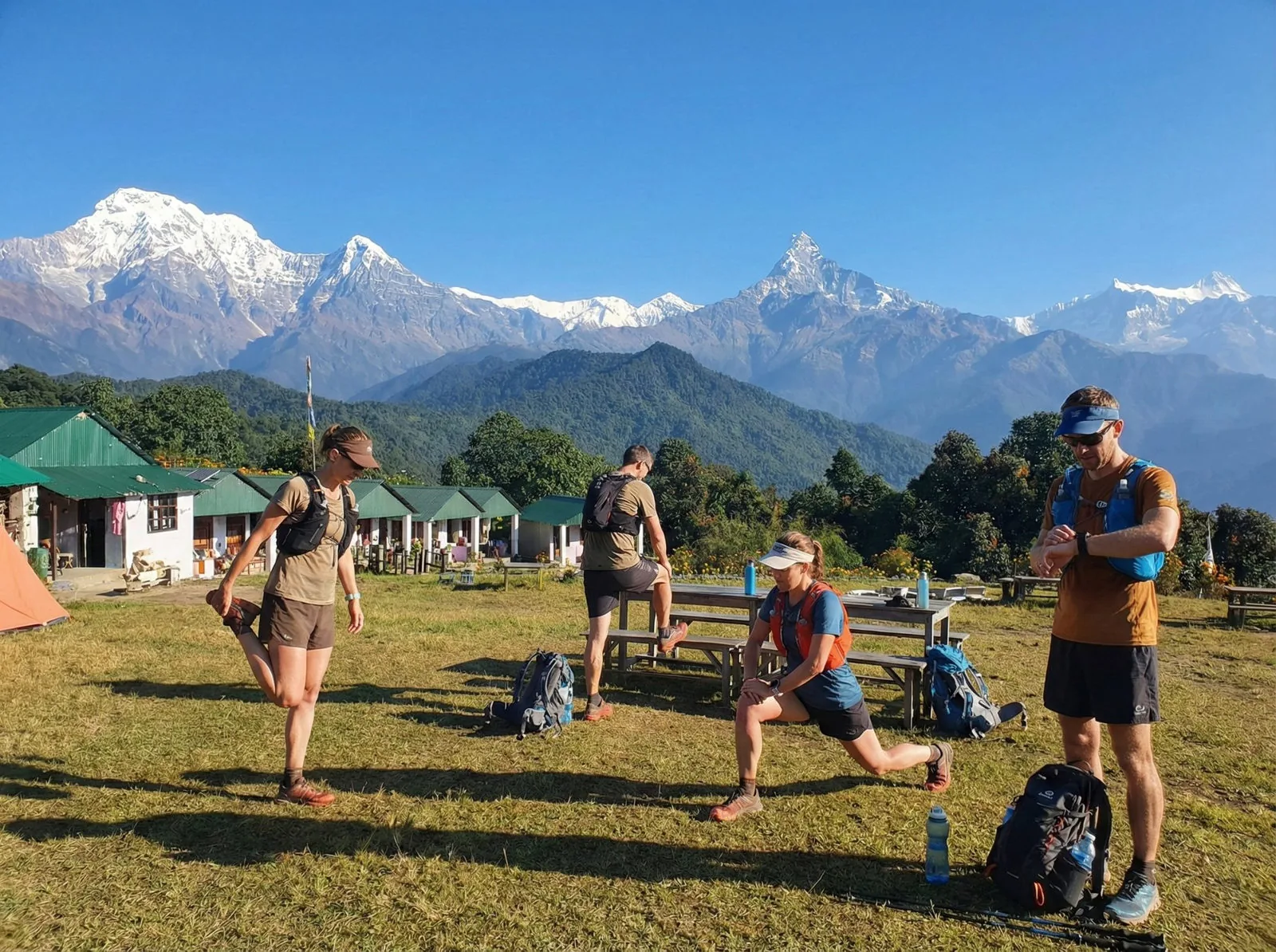
What if we told you there's a trail in Nepal that takes you from the shores of a lake to the foot of an 8,000-metre peak — and back — in six days?
Not a trek. Not a race. A trail running camp through the heart of the Annapurna foothills, where every morning you wake up closer to the mountains and every evening you fall asleep to the sound of a village settling into silence.
If the Pokhara Trail Running Camp is where you remember why you started running, the Annapurna Foothills is where you discover how far that feeling can take you.
Two Public Departures in 2026
We open two public camps this year, each limited to 12 runners maximum — small enough to feel personal, big enough to create real connection.
| Departure | Dates | Price |
|---|---|---|
| Spring Camp 🌸 | April 26 – May 1, 2026 | From $600 USD per person |
| Autumn Camp 🍂 | November 19 – 24, 2026 | From $600 USD per person |
Pricing depends on group size — from $500 per person for groups of 10-12 up to $700 for a pair. Prefer your own dates? Private camps are available year-round — more on that below.
The Route — 135 km Through the Annapurna Foothills
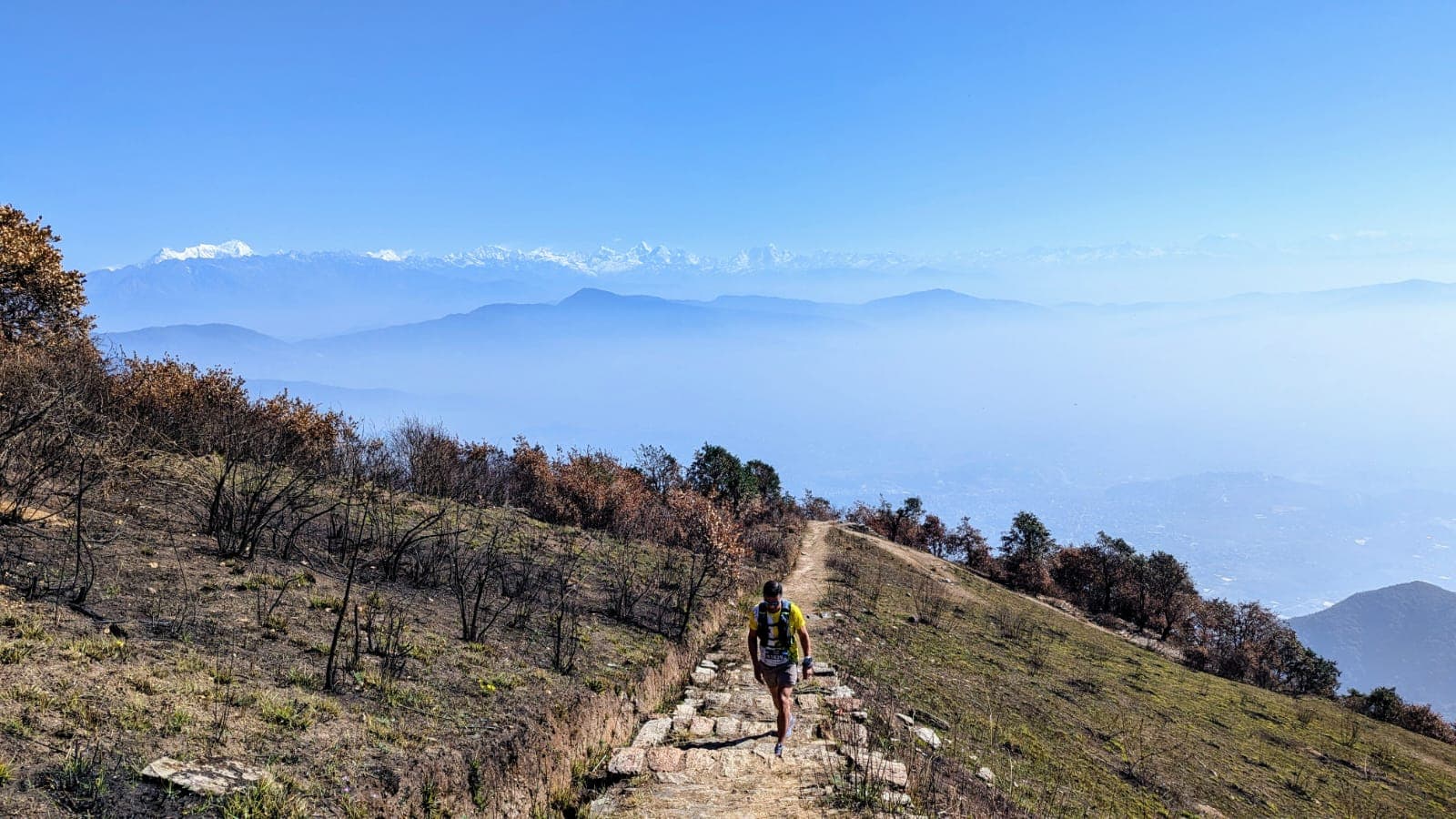
Starting from the outskirts of Pokhara and finishing in Ghorepani — one of the most iconic viewpoints in the Himalayas — the route takes you through rhododendron forests, terraced hillsides, ancient Gurung villages, natural hot springs, and up to the Mulde Viewpoint at 3,637 metres — where the entire Annapurna range, Dhaulagiri, and Machhapuchhre stand in front of you like a wall of ice and light.
| Day | Route | Distance | Elevation | Duration |
|---|---|---|---|---|
| Day 1 | Pokhara → Jhuma Danda | 16 km | +758 m | 3–4 hrs |
| Day 2 | Jhuma Danda → Bhadaure via Panchase (2,500 m) | 18.5 km | +920 m | 4 hrs |
| Day 3 | Bhadaure → Jhinu Danda via Australian Base Camp | 22 km | +440 m | 4–5 hrs |
| Day 4 | Jhinu Danda → Tadapani | 9 km | +570 m | 2–3 hrs |
| Day 5 | Tadapani → Ghorepani via Mulde Viewpoint (3,637 m) | 14.5 km | +1,007 m | 3–4 hrs |
| Day 6 | Ghorepani → Patichaur → Return Pokhara | 25 km | -2,815 m | 5–6 hrs + drive |
Around 135 km total across six days, with 6 to 7 hours of activity per day. That's real mountain terrain — technical, varied, and deeply rewarding.
This is longer and more immersive than our 4-day Pokhara camp. You go deeper into the mountains. You climb higher. You spend more days on the trail, and the trail gives you more in return.
Six Days, Six Stories
Day 1 — Pokhara to Jhuma Danda
The camp begins at the edge of Pokhara, where the city gives way to the hills within minutes. The first stage climbs through farmland and scattered villages, past the Peace Pagoda — that iconic white stupa perched above the valley — and into the forest. By mid-afternoon, you arrive at Jhuma Danda, a quiet ridgeline settlement where the only sound is wind through the trees and the distant clang of a cowbell.
It's an introduction. A handshake between you and the mountains. The legs are fresh, the pack is light, and the Annapurna range is already watching you from across the valley.
Day 2 — Jhuma Danda to Bhadaure via Panchase
This is where things get serious — and seriously beautiful. The trail climbs through dense forest up to Panchase Top at 2,500 metres, one of the finest viewpoints in the region. From up there, you can see three of the ten highest mountain ranges on Earth. Annapurna. Dhaulagiri. Manaslu. All at once. The kind of view that makes you stop mid-stride and forget what you were doing.
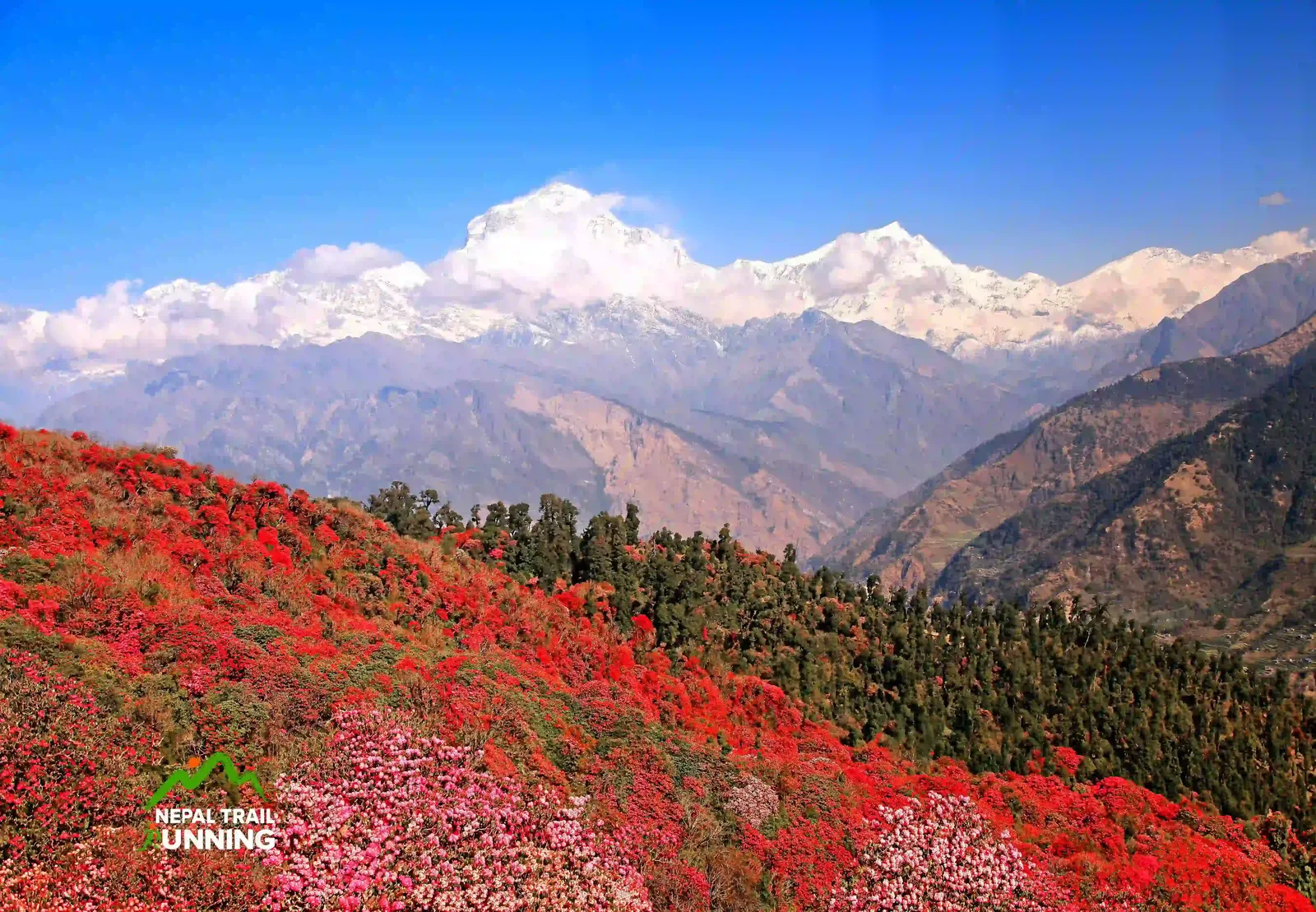
The descent to Bhadaure winds through oak and rhododendron forest. In spring, the rhododendrons are in full bloom — red, pink, and white flowers covering the canopy like something out of a painting. In autumn, the forest is golden and the air is sharp.
Either way, the tea at the bottom tastes incredible.
Day 3 — Bhadaure to Jhinu Danda via Australian Base Camp
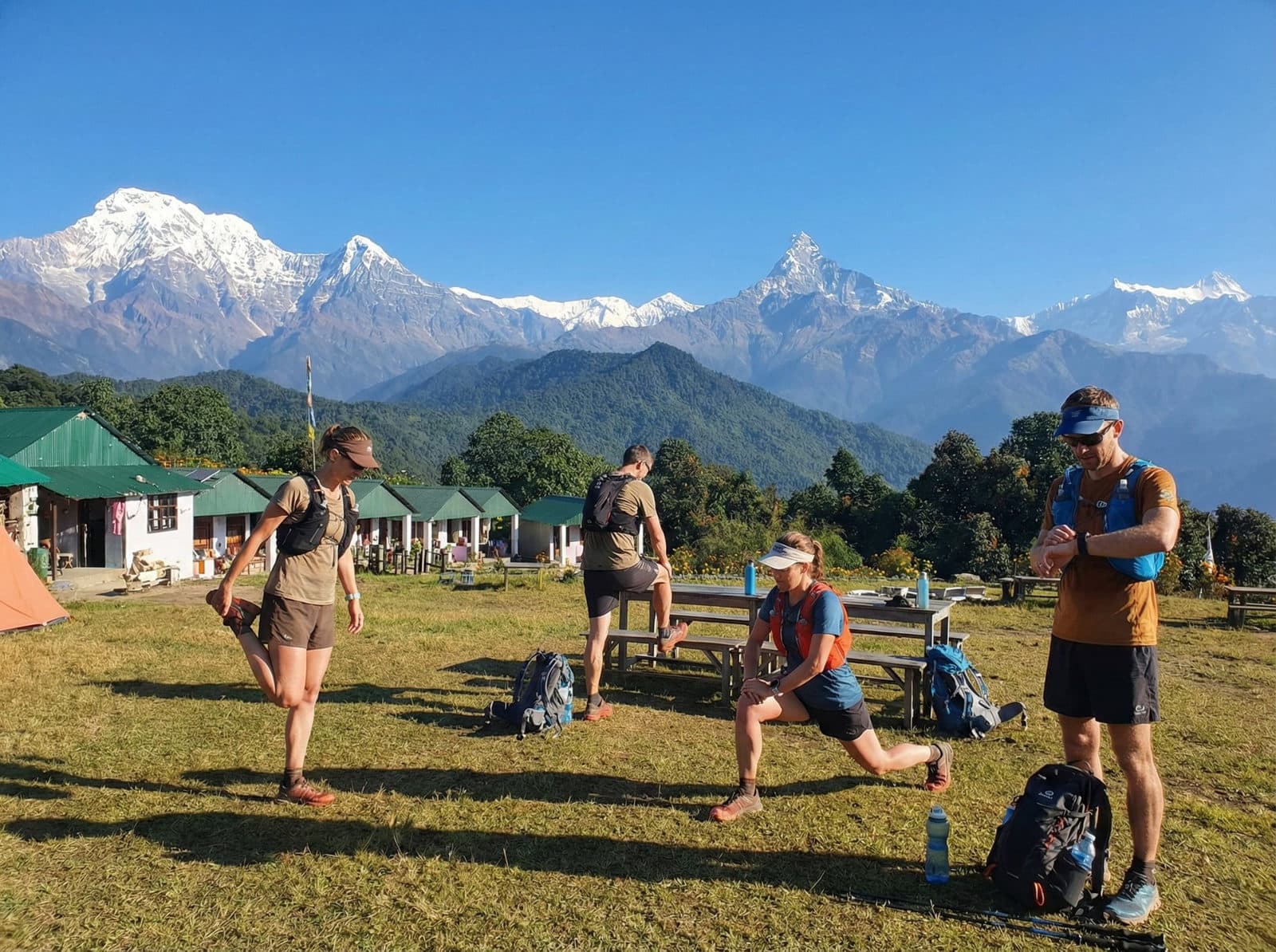
The longest day of the camp — and arguably the most rewarding. The trail crosses through Australian Base Camp, a clearing perched on a hillside with a front-row view of the Annapurna range that's so close it feels like you could reach out and touch it.
Then comes the descent to Jhinu Danda — a steep, switchbacking trail down to the Modi Khola river valley. And at the bottom, waiting for you after 22 kilometres of mountain running: natural hot springs.
Sitting in hot water with tired legs while a Himalayan river rushes past and the mountains tower above you — that's not something you forget.
Day 4 — Jhinu Danda to Tadapani
A shorter day. A recovery day — sort of. The trail climbs from the river valley up through the village of Chhomrong, a major Gurung settlement clinging to the mountainside, and on to Tadapani.
This is the day where the camp shifts gear. The legs have found their rhythm. The body has adapted. And the mind is somewhere it hasn't been in a long time — quiet.
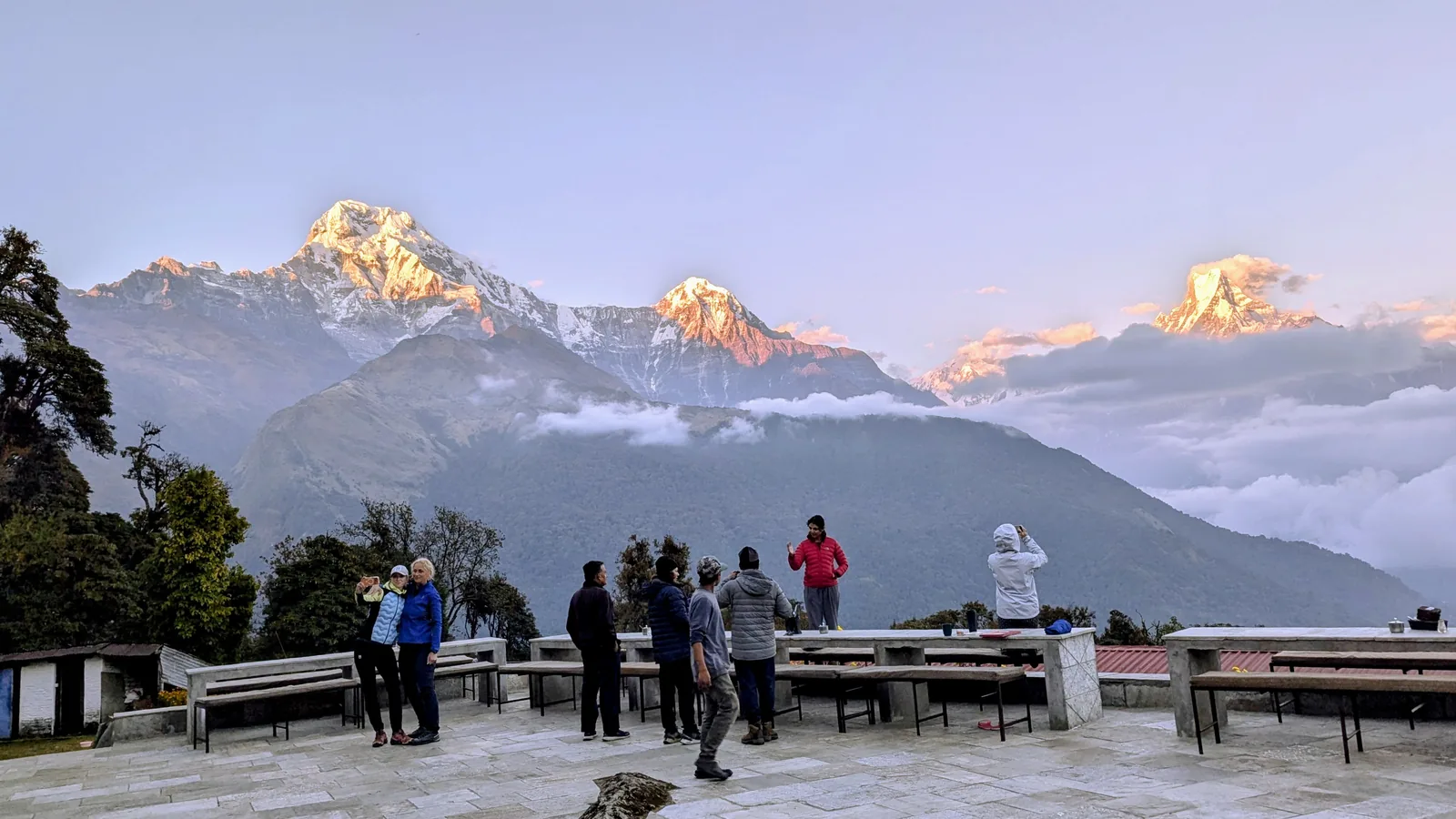
Tadapani sits in a forest clearing with views of Machhapuchhre — the sacred Fishtail peak — directly in front of you. There are worse places to spend an afternoon with a cup of tea.
Day 5 — Tadapani to Ghorepani via Mulde Viewpoint
The high point of the camp — literally. The trail climbs through dense forest and open ridgelines to Mulde Viewpoint at 3,637 metres. This is the highest point of the route, and the reward is a 360-degree panorama of the Annapurna and Dhaulagiri ranges that will redefine what you think a view can be.
The descent to Ghorepani is fast and technical — single-track through the forest with roots and rocks keeping you honest. By the time you arrive in the village, the legs are humming and the mind is buzzing.
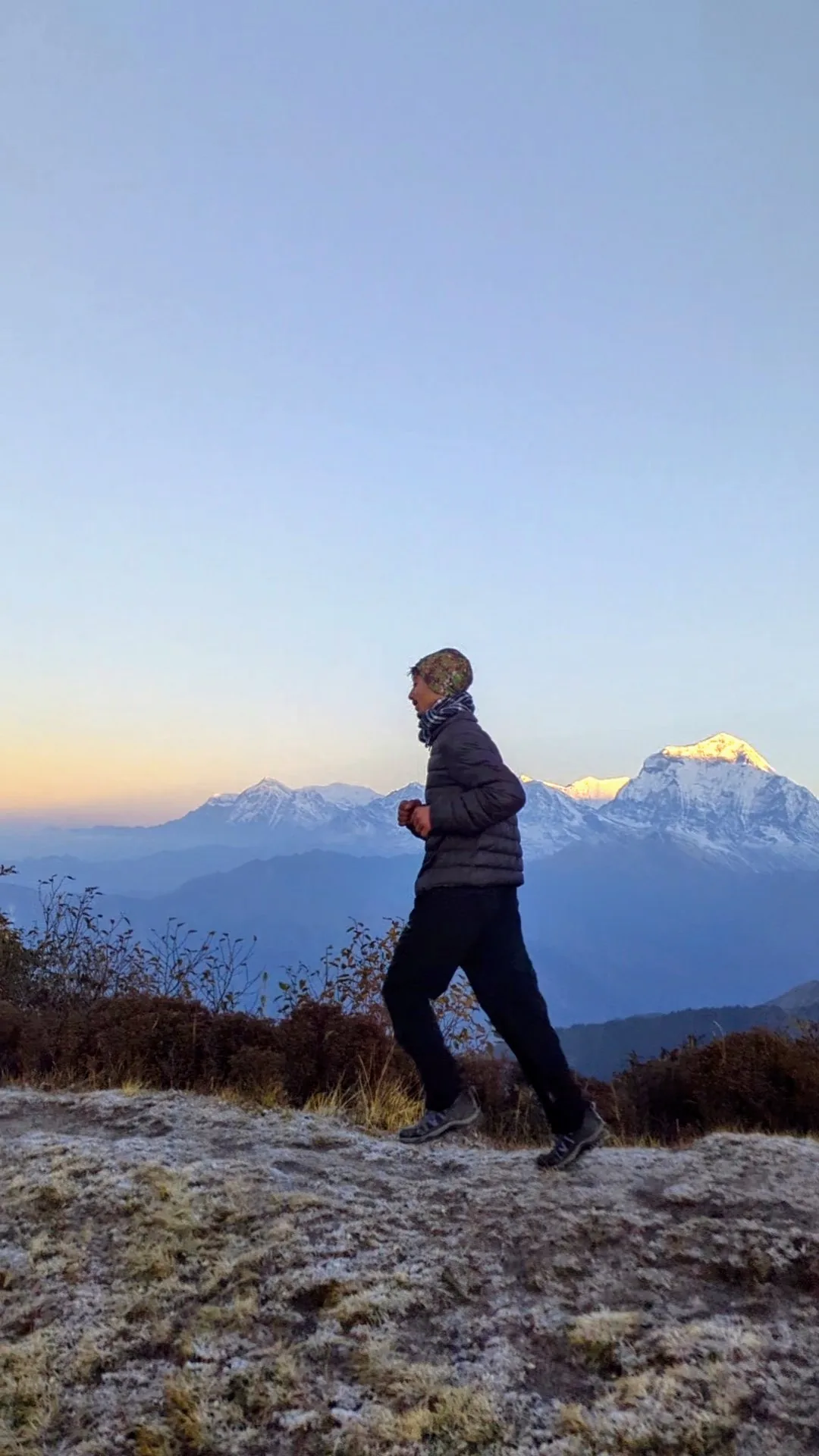
Ghorepani is famous for its sunrise. And tomorrow morning, you'll understand why.
Day 6 — Ghorepani to Patichaur, Return to Pokhara
The final day. The big descent. 25 kilometres of downhill running through Mohare Danda and Lespar village, dropping nearly 2,800 metres back to the lowlands. This is where all the descending practice pays off — fast, flowing, and exhilarating.
It's a long day, and by the time you reach Patichaur and climb into the jeep back to Pokhara, your legs will know they've run. But there's a lightness in your chest that wasn't there six days ago. Something has shifted.
Back in Pokhara, the lake is calm. The mountains are glowing in the late afternoon light. And you've just run 135 kilometres through the foothills of the Annapurna range.
Let that sink in.
Is This Camp For You?
Let's be honest: six days of mountain trail running is not a casual commitment.
Covering 15 to 22 kilometres per day with 6 to 7 hours of activity, on technical mountain terrain that climbs to 3,637 metres — this camp requires a real training base before you arrive.
But you don't need to be an elite runner. You don't need ultra experience or altitude credentials. What you need is a genuine love for trail running, regular training on varied terrain, the ability to run and hike for several hours on consecutive days, and a willingness to embrace the mountains — to go slow when they ask you to, to push when the trail opens up, and to stay present when the views try to steal your concentration.
We grade this camp as moderate. If you've been running consistently and you're looking for something that goes beyond a weekend race — something that challenges you physically and changes something inside — this is it.
More Than Running — What the Foothills Teach You
Everything we said about the Pokhara camp applies here, amplified by two extra days and a thousand extra metres of altitude.
You'll work on altitude adaptation — learning how your body responds when the air gets thinner and the trail gets steeper. You'll develop your technical trail skills — reading terrain, adjusting your stride on roots and rocks, finding flow on surfaces that change every hundred metres. You'll practice descending — properly, efficiently, without destroying your quads by Day 3. And you'll learn effort management across multiple days — the art of running by feel, of knowing when to push and when to hold back, of arriving at camp each evening with enough left for tomorrow.
But the real lessons come from the trail itself.
Six days is enough time to let go. The watch stops mattering somewhere around Day 2. The pace stops mattering somewhere around Day 3. By Day 4, you're running because it feels good — because the forest smells like pine and the mountains are pink in the morning light and the person next to you just said something that made you laugh out loud.
By Day 6, you've remembered something important. Something the mountains have been trying to tell you since you arrived.
The Villages, the Culture, and the Soul of the Foothills
Running in the Annapurna foothills is running through living history.
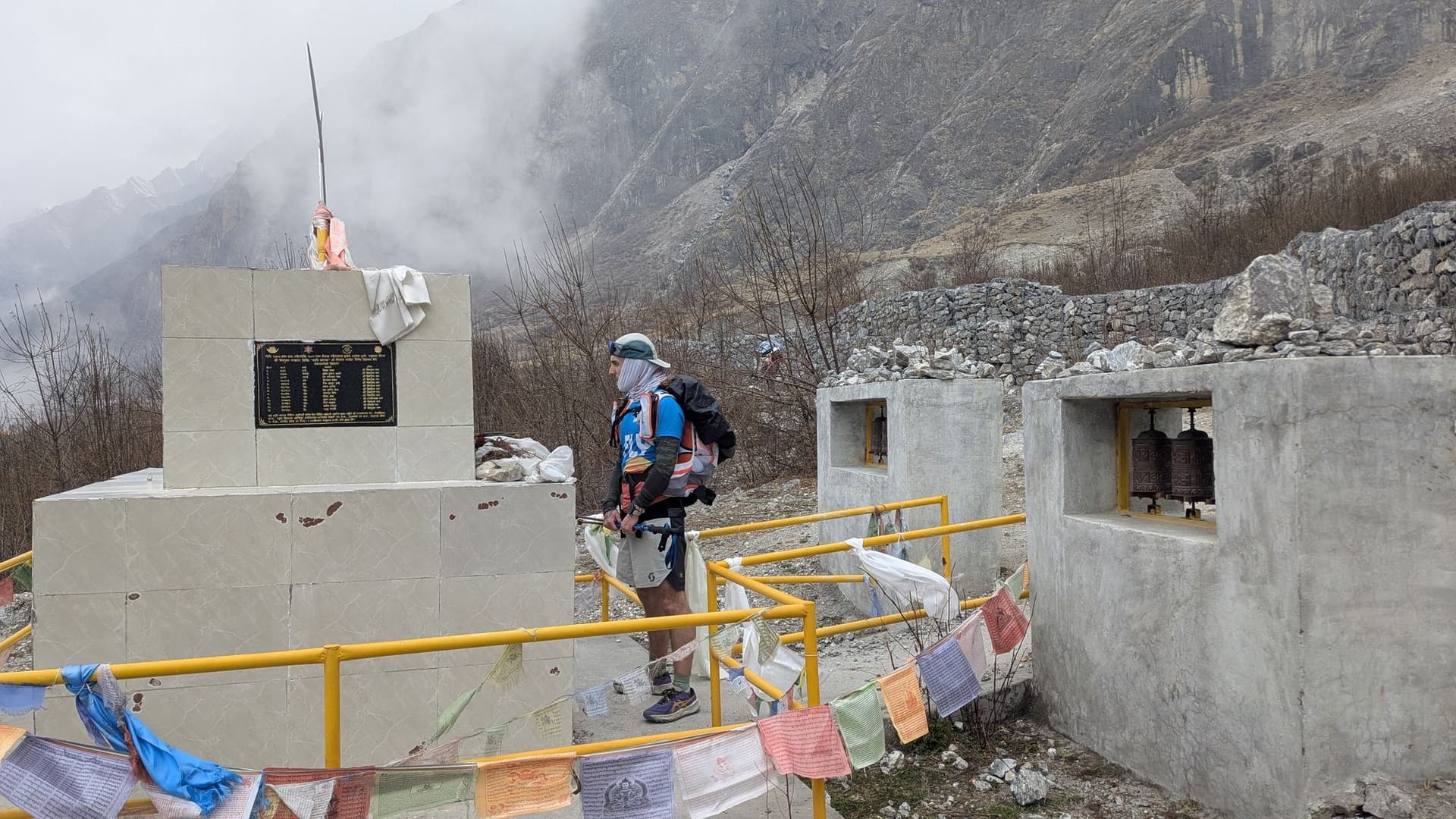
The Gurung villages along this route — places like Chhomrong, Landruk, Ghandruk — have been here for centuries. Stone houses with slate roofs, prayer flags catching the wind, terraced fields that cascade down hillsides like green staircases. These are communities that live with the mountains, not against them.
Every evening, dinner is served around a shared table in a teahouse. Dal bhat — rice, lentils, vegetables, pickles — the fuel that powers Nepal. The warmth of the kitchen, the laughter of the teahouse owner, the quiet satisfaction of a full belly after a long day on the trail. These moments are as much a part of the experience as the running.
In Jhinu Danda, you'll soak in hot springs that bubble up from the earth beside the river. In Ghorepani, you'll watch the sun set over Dhaulagiri while the village prepares for the night. In the forest between Tadapani and Mulde, you might see nothing but trees and birds for hours — and that silence is its own kind of gift.
Nepal has a way of reminding you that the most important things are also the simplest. A hot meal. A warm bed. A view that makes you stop breathing for a second. A stranger who becomes a friend over six days on the trail.
Why Nepal Makes You a Better Runner
There's something that happens when you spend six days running in the Himalayas. You come back different. Not just fitter — recalibrated.
The simplicity of life in the mountain villages. The generosity of people who have very little but share everything. The scale of the peaks above you, making every human concern feel appropriately small. The physical challenge of running day after day on terrain that never lets you go on autopilot.
All of it works on you. Quietly, steadily, like the river carving through the valley below.
You remember why you started running. Not for the medals or the Strava kudos or the race photos. For the feeling. For the freedom. For the version of yourself that only shows up when you stop performing and start moving.
Carry that back with you, and everything changes.
Your Team on the Trail
Gregory, co-founder of Nepal Trail Running, is a French trail runner and the heart behind this project. Not a coach by title — but a passionate runner who built this adventure from love for the sport and love for Nepal. Gregory will be there to welcome you, walk you through everything before you set off, and follow up after the camp to make sure the experience stays with you.
Mohan, co-founder of Nepal Trail Running and founder of North Nepal — a trekking and adventure company with decades of Himalayan expertise — handles every logistical detail of your camp. From permits to porters, from teahouse reservations to emergency protocols, Mohan's operational knowledge is simply unmatched. In the mountains, he leads the way.
Jiban runs alongside you — a talented trail runner who knows these trails intimately. Every shortcut, every hidden viewpoint, every teahouse where the dal bhat is best. His energy on the trail is contagious.
Your bag is carried by a porter who departs ahead of the group each morning. You keep only what you need for the day — water, a snack, a layer. By the time you arrive at the teahouse, your bag is already there. You run light. You run free.
What's Included
Everything you need is covered:
- Experienced mountain guide with safety certification
- Porter services for luggage transport
- 3 meals per day — breakfast, lunch, and dinner
- Tea and coffee service
- Teahouse and guesthouse accommodation for 5 nights
- All trekking permits — ACAP and TIMS
- First aid kit with oximeter for altitude monitoring
- Fresh and dry fruit along the trail
- Morning and evening briefings
- Achievement certificate
- All government taxes and administrative fees
Not included: Personal equipment, tips for guides and porters, personal extras, travel insurance, and emergency evacuation costs.
Pricing
| Group Size | Price Per Person |
|---|---|
| 2 runners | $700 USD |
| 3–5 runners | $600 USD |
| 6–9 runners | $550 USD |
| 10–12 runners | $500 USD |
Solo travelers — contact us for a customized package.
Private Trail Camps — Available Year-Round
The public camps are perfect for solo travelers or pairs who want to join a ready-made group. But if you want complete flexibility, private trail camps are available any time of year on the same route — or on a customized itinerary built around your goals.
Private camps are ideal for friends or couples who want their own pace, running clubs planning a group adventure, runners who want a more focused technical experience, or anyone who simply prefers a private journey through the mountains.
Contact us directly and we'll build something around you.
When to Come — Every Season Has Its Magic
Spring (late April – May) is magical. The rhododendron forests explode into colour — red, pink, white — creating a canopy that looks like it was painted by hand. The mornings are warm, the skies are clear, and the mountains are sharp against the blue. Our April public camp falls right in the heart of spring — one of the best times to be on the trail.
Autumn (September – November) is Nepal at its most spectacular. The monsoon has washed everything clean, the air is crystalline, and the mountain views are the sharpest of the year. The trails are dry, the temperatures are perfect for running, and every ridgeline panorama is a photograph waiting to happen. Our November camp catches the tail end of peak season — golden light, empty trails, and the Annapurna range in full glory.
Winter (December – February) is underestimated. Because this route stays at moderate altitude, the cold is manageable and the snow is rare below Ghorepani. What you get is exceptional visibility, empty trails, and a stillness in the mountains that's hard to find at any other time. The winter sky in Nepal is extraordinary.
Summer (June – August) is the monsoon — lush, green, alive. The forest is thick, the waterfalls are full, and the light through the canopy is beautiful. The trails can be muddy and the mountain views sometimes hidden by cloud, but there's a raw beauty to the monsoon season that rewards those who don't mind the rain.
The Difference Between 4 Days and 6 Days
If you've read our Pokhara Trail Running Camp blog, you might be wondering: which one is for me?
The 4-day Pokhara camp is an introduction. It's accessible, it's powerful, and it's perfect for runners who want their first taste of trail running in Nepal — or who have limited time. You stay in the Pokhara valley, reach Panchase at 2,500 metres, and finish with a boat ride across Fewa Lake.
The 6-day Annapurna Foothills camp goes deeper. Deeper into the mountains, deeper into the culture, deeper into the kind of running that changes something inside you. You climb to 3,637 metres. You soak in hot springs. You run through some of the most iconic trail running terrain in the Himalayas — Ghorepani, Mulde, Australian Base Camp. You have two extra days to let go, to find your rhythm, to fall in love with the trail.
Both camps are unforgettable. But if you have the time and the fitness, the 6-day camp is the full experience.
Ready to Come?
Spots are limited to 12 runners per departure.
Spring Camp: April 26 – May 1, 2026 Autumn Camp: November 19 – 24, 2026
To reserve your place:
👉 Register here 📩 [email protected] 💬 WhatsApp Gregory: +33 7 44 74 73 94 💬 WhatsApp Nepal team: +977 9846816904
We'll send you a complete pre-camp guide — everything you need to know about preparation, gear, travel, and what to expect on the trail.
The mountains don't care about your pace. They don't care about your finish time. They care that you showed up.
Come and run. Come and breathe. Come and discover what six days in the Annapurna foothills can do to you.
We'll see you on the trail. 🏔️
Namaste. 🙏
Nepal Trail Running organizes guided trail running camps, private adventures, and group events across the Annapurna, Everest, Manaslu, and West Nepal regions. All levels welcome — all we ask is that you come with an open heart.